fxd filler×dissolve
v1.0 · Decision support · Patient education

Evidence-based hyaluronidase dosing for HA filler dissolution.

For licensed injectors: a planner that compiles the patient's filler history and returns a per-region hyaluronidase plan grounded in current literature. For patients: clear, sourced answers about what dissolution involves.

Clinical decision support — not a directive. For use by licensed injectors only. Output is a starting estimate based on published in vitro data and clinical convention. Final dosing requires direct patient assessment, anatomic judgment, and the injector's discretion. Hyaluronidase use for filler dissolution is off-label.
01 — Dissolution Planner

Compile the filler history. Get a per-region plan.

For injectors and patients alike. Add every filler product, volume, and region — the planner returns the anticipated hyaluronidase dose, vials, and draw-up per area. Patients can print or save the record as a PDF to bring to their dissolver.

Anatomic reference Facial regions reference
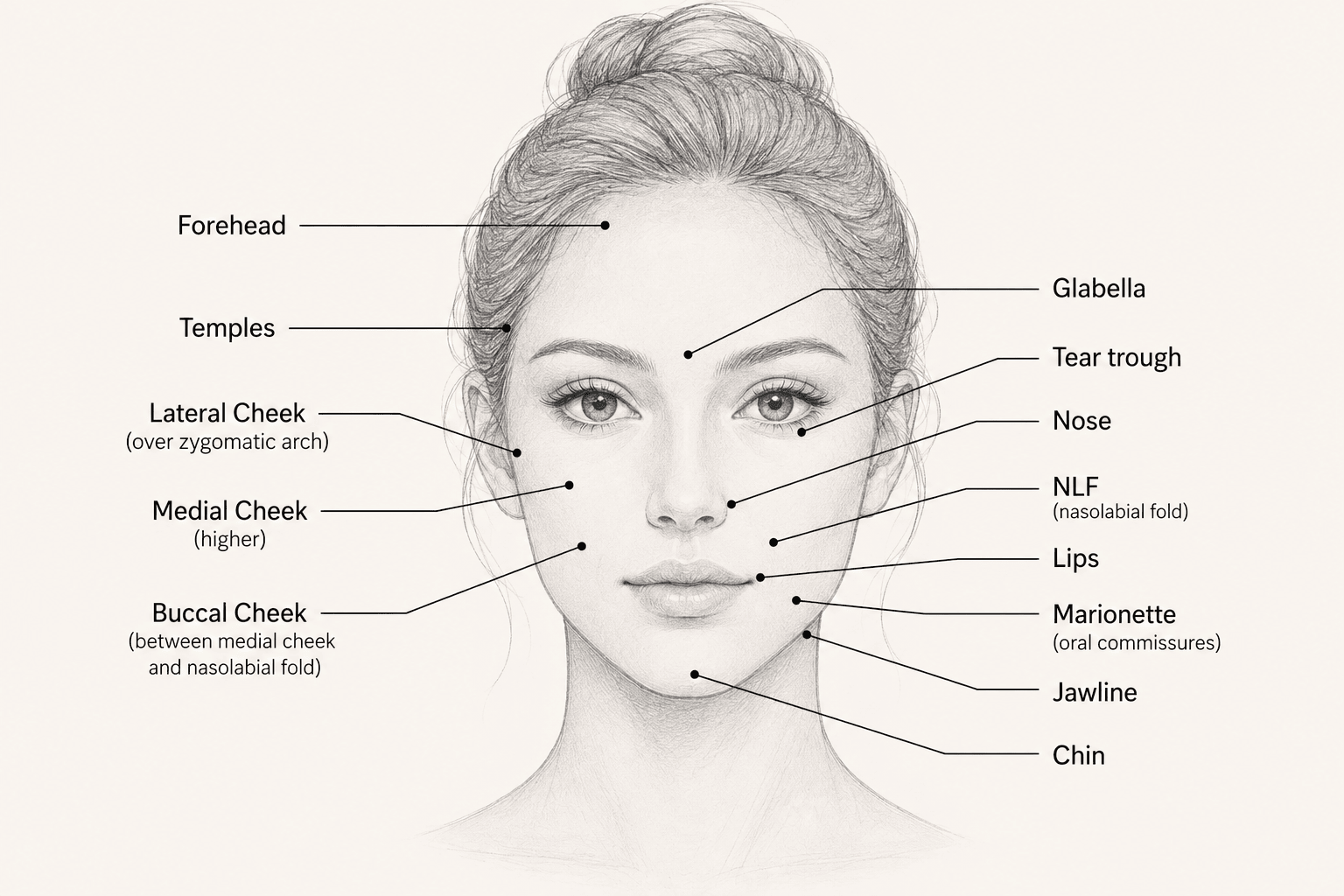
Click image to enlarge. Use the quick-pick or filler dropdown to add entries.
Patient filler history
Dissolution plan — per region

Per-filler baselines pulled directly from the Safran 2025 RHH chart (U recombinant human hyaluronidase / 0.2 mL filler, complete dissolution at one hour, 3:1 dilution; range 2–140 U, ceiling = Belotero Volume at 140 U). Tissue is not a beaker — use the clinical factor below to scale for in-tissue diffusion, chronic filler, high cumulative volume, or known-resistant patient history.

Clinical factor 1.0×
1.0× chart baseline 1.5× standard tissue 2.0× chronic / high-resistance

In vitro chart value — no in-tissue scaling. Use for direct comparison to published Safran 2025 dissolution data.

×
Add at least one filler entry above to build a dissolution plan.

Honest answers about filler dissolution.

Most of what's online about HA filler is marketing or anecdote. These answers aren't.

If you're considering dissolution — or wondering whether you should be — start here.

Build your filler record

Use the planner above to log every filler you've had — product, region, volume, year. Then print or save it as a PDF. Bring it to your dissolver and they'll have everything they need.

Open the planner
+ What is hyaluronidase?

An enzyme that breaks down hyaluronic acid (HA). HA is what most modern dermal fillers are made of. Hyaluronidase — sold under names like Hylenex and Vitrase — is the only widely available agent that dissolves these fillers.

Its use for filler dissolution is off-label: the FDA approved the drug for other purposes (helping fluid spread through tissue during surgery), and injectors apply it to filler dissolution based on clinical experience and a growing body of literature.

+ Why does dissolution sometimes take more than one session?

Modern fillers vary widely in resistance to hyaluronidase. Cross-linking technology and HA concentration both affect how quickly they dissolve. Recent in vitro work (Sudharshan 2025, Safran 2025) measured the doses required across the major products — values range from a few units up to 140 U per 0.2 mL of filler.

In tissue, several factors can reduce effective enzymatic activity:

  • The enzyme is partially inactivated by surrounding tissue
  • The extracellular matrix slows how the enzyme reaches the filler
  • Endogenous hyaluronic acid competes for the same enzyme

For higher-volume or more resistant products, a single session may not be enough.

+ How do I know if I have too much filler?

Common signs:

  • Persistent under-eye puffiness or shadow that doesn't resolve with sleep
  • A visible "shelf" or step-off where filler has migrated
  • A heavy, full, or jowled feeling in the midface that wasn't there before
  • A bluish hue under thin skin (the Tyndall effect)
  • Facial proportions that have shifted gradually over years of treatment

If you've had filler for five or more years across multiple sessions, you likely have more residual material than you — or your injector — assume.

+ What is post-hyaluronidase syndrome?

A pattern described in recent literature where tissue around dissolved filler develops chronic swelling, distortion, or volume loss in the months following treatment.

Reported correlations include the volume of filler present and how long it had been in place. Concentration of hyaluronidase used during dissolution has not been a consistently reported predictor.

+ How is dissolution different from injection?

Injection adds material; dissolution removes it. Both require anatomic precision, but dissolution carries a different risk profile.

Hyaluronidase can affect your body's own (endogenous) HA. The procedure often requires multiple sessions. The tissue being treated has been altered by years of filler placement.

Choose an injector who treats dissolution as its own clinical procedure — not as a quick reversal.

+ What questions should I ask before dissolution?
  • How many vials of Hylenex are you planning to use?
  • What dilution ratio? (3:1 is the most evidence-supported)
  • Are we planning one session or several?
  • What's your protocol if I have a vascular complication during the procedure?
  • How long until I see the final result?
  • What's your honest assessment of how much filler is actually present?

If your injector can't answer these clearly, find one who can.

+ Why do dosing recommendations vary so widely?

Recommendations have evolved as new in vitro data has emerged. Earlier guidance reflected an earlier generation of products. Recent studies (Sudharshan 2025, Safran 2025, Faivre 2024) measured the actual doses required to dissolve modern fillers, with significant variation by manufacturing technology.

The planner uses Sudharshan's per-filler in vitro values directly as its baseline.

+ Where is the data still developing?

Randomized controlled trials specific to facial filler dissolution remain limited (Borzabadi-Farahani 2024). Most current dosing guidance comes from in vitro studies and clinical case series.

Clinical decisions should integrate this evolving literature with direct patient assessment by a qualified injector.

03 — Evidence base

Behind the dosing.

Recent literature on hyaluronidase-mediated HA filler dissolution that informs the planner.

  • 01
    In vitro minimum doses span 2.5 to 140 U / 0.2 mL across 22 commercially available HA fillers (Sudharshan 2025). Per-filler baselines in the planner are taken directly from this dataset.
  • 02
    300 U is sufficient to dissolve the most resistant fillers within one hour at a minimum 3:1 dilution (Safran 2025). Both ovine and recombinant human formulations performed similarly.
  • 03
    Manufacturing technology drives resistance. Vycross fillers cluster at the resistant end; CPM (Belotero) at the susceptible end (Faivre 2024). Brand alone is less predictive than the underlying technology.
  • 04
    HA concentration as a secondary variable. Higher mg/mL corresponds to slower hydrolysis, and active mixing is required to initiate enzymatic effect (Handfield 2025).
  • 05
    Periorbital cohort dosing. Mean ~350 IU per lower eyelid in a single session resolved a range of complications across 54 patients (Chen 2026).
  • 06
    Lip-specific resistance. Restylane Kysse most susceptible; Juvederm Ultra most resistant in the Demir & Tayfun 2025 lip-filler ranking.
  • 07
    Cross-linking technology > HA concentration as the determinant of degradability (Gerber 2023; consistent with Faivre 2024).
  • 08
    Vascular emergency vs. nodule dissolution. Low-dose intralesional injection for overcorrection; high-dose flushing for vascular accidents (Landau 2015).
04 — References

The literature this app is built on.

A curated set of recent studies driving the planner's per-filler baselines, region notes, and reconstitution defaults.

Sudharshan 2025 Minimum hyaluronidase dose across 22 HA fillers (in vitro). Values from 2.5 to 140 U / 0.2 mL. Anchors the per-filler baselines used here.
Safran 2025 Ovine vs. recombinant human hyaluronidase. 300 U sufficient to dissolve 0.2 mL of the most resistant fillers in one hour at minimum 3:1 dilution. Both formulations performed similarly.
Faivre 2024 Manufacturing technology as the dominant resistance variable. 16 fillers across 6 technologies. Vycross most resistant; CPM least.
Chen 2026 Periorbital high-dose hyaluronidase. 54 patients, single session, mean ~350 IU per lower eyelid resolved a range of complications without retreatment.
Handfield 2025 HA concentration and active mixing. HA concentration is a critical secondary variable; active mixing required to initiate enzymatic effect.
Demir & Tayfun 2025 Lip filler susceptibility ranked. Six lip fillers by Morgan-Elson assay. Restylane Kysse most susceptible; Juvederm Ultra most resistant.
Arrigoni 2025 Comprehensive review of hyaluronidase in aesthetic medicine. Formulations, dosing strategies, imaging-guided protocols, 2020–2025 safety data.
Borzabadi-Farahani 2024 Scoping review. Five RCTs (53 subjects) supporting hyaluronidase for uncomplicated nodules. No RCT-level evidence for facial reversal or vascular complication management.
Gerber 2023 Time- and dose-dependent dissolution of nine HA fillers. Cross-linking technology more important than HA concentration in determining degradability.
Zhang-Nunes 2021 In vivo RCT — three fillers. Restylane-L, Juvederm Ultra, Voluma. Voluma required >20 U / 0.2 mL. Four-year follow-up.
Ugradar 2021 Particle-size analysis. Modest breakdown of Restylane, Voluma, Belotero after 450 U at 30 minutes.
Landau 2015 Hyaluronidase caveats. Low-dose intralesional for overcorrection; high-dose flushing for vascular accidents.